


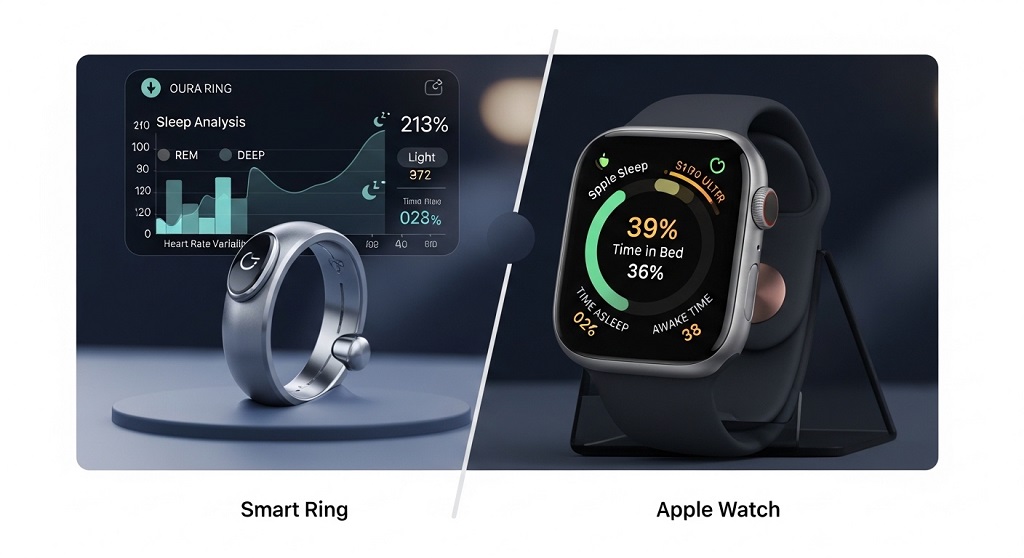
24 Mar How to Choose Between a Smart Ring and an Apple Watch for Better Sleep Tracking
If your goal is accurate, comfortable, and consistent sleep tracking, both smart rings and the Apple Watch can help—but they serve different users. A smart ring is better for passive overnight tracking with minimal distraction. The Apple Watch is better if you also want health apps, notifications, workouts, and daily smartwatch features.
Sleep tracking matters because poor sleep affects memory, mood, metabolism, and productivity. According to data from the Centers for Disease Control and Prevention (CDC), about one-third of adults do not get enough sleep regularly. Wearable sleep trackers help identify patterns such as sleep duration, restlessness, and recovery readiness.
But choosing between a smart ring and an Apple Watch is not simple. Both devices collect heart rate, movement, and sleep stage data. However, they differ in comfort, battery life, accuracy methods, and long-term usability.
This guide explains how each device works, compares real-world performance, and helps you choose the right option based on your lifestyle and sleep goals.
Why Does Sleep Tracking Matter Before Choosing a Device?
Short answer: Sleep tracking helps identify patterns that affect recovery, energy, and long-term health.
Sleep trackers measure:
- Total sleep time
- Sleep stages (light, deep, REM)
- Heart rate variability (HRV)
- Resting heart rate
- Movement during sleep
- Respiratory trends
A 2020 validation study published in Nature and Science of Sleep showed wearable sleep devices can estimate total sleep time with reasonable reliability when compared with polysomnography, the clinical gold standard. While they are not medical devices, they provide useful behavioral insights.
This makes choosing the right wearable important if your goal is improving sleep quality rather than just collecting data.
What Is a Smart Ring and How Does It Track Sleep?
Short answer: A smart ring tracks sleep using infrared sensors that measure pulse, movement, temperature, and recovery signals while remaining comfortable overnight.
Popular smart rings like the Oura Ring use:
- Infrared photoplethysmography (PPG)
- Skin temperature sensors
- Motion detection accelerometers
- Heart rate variability tracking
Because the finger has strong blood flow signals, smart rings often capture more stable heart rate data than wrist devices during sleep.
A 2022 independent validation study found the Oura Ring detected sleep stages with about 79% agreement compared with clinical sleep lab equipment. That level is typical for advanced consumer wearables.
The biggest advantage is comfort. Users often forget they are wearing the ring, which improves long-term tracking consistency.
How Does the Apple Watch Track Sleep Compared to a Smart Ring?
Short answer: The Apple Watch tracks sleep using wrist movement, heart rate sensors, and machine learning models integrated with Apple Health.
The Apple Watch measures:
- Sleep duration
- Sleep stages
- Respiratory rate
- Heart rate
- Sleep consistency
Apple introduced advanced sleep-stage tracking starting with watchOS 9. The system uses accelerometer motion signals and heart rate variability to estimate REM, deep, and core sleep phases.
Unlike smart rings, the Apple Watch integrates sleep tracking with:
- Fitness tracking
- Workout recovery metrics
- Stress monitoring apps
- Daily activity rings
This makes it a broader health ecosystem device rather than a sleep-only wearable.
Which Device Is More Accurate for Sleep Tracking?
Short answer: Smart rings are generally more consistent overnight, while Apple Watch provides reliable stage estimates but depends on battery usage habits.
Accuracy depends on three factors:
- Sensor location
- Signal quality
- Wear consistency
The finger provides stronger pulse signals than the wrist. This improves HRV tracking accuracy during sleep.
However, Apple Watch benefits from advanced machine learning algorithms trained on large datasets.
| Feature | Smart Ring | Apple Watch |
|---|---|---|
| Heart rate stability | High | Moderate to high |
| Sleep stage tracking | Strong | Strong |
| Movement detection | Moderate | High |
| Recovery metrics | Advanced | Moderate |
In practice, both devices perform well. The difference appears mainly in long-term recovery insights.
Which Device Is More Comfortable for Overnight Wear?
Short answer: Smart rings are more comfortable for most users because they are lightweight and distraction-free.
Comfort affects data quality. If users remove the device during sleep, tracking becomes unreliable.
Common comfort differences include:
- Smart rings weigh 4–6 grams
- Apple Watch weighs 30–50 grams
- Rings do not emit screen light overnight
- Watches may feel bulky for side sleepers
Many users report forgetting they are wearing a smart ring after a few nights. That consistency improves trend accuracy over time.
How Does Battery Life Affect Sleep Tracking Performance?
Short answer: Smart rings last longer per charge, making them easier to use for continuous overnight tracking.
Battery habits influence whether sleep tracking remains consistent.
- Smart ring battery: 4–7 days
- Apple Watch battery: 18–36 hours
Because the Apple Watch often needs daily charging, users sometimes remove it at night. That reduces sleep dataset continuity.
Smart rings typically recharge during short daytime breaks instead.
Which Device Provides Better Recovery and Readiness Insights?
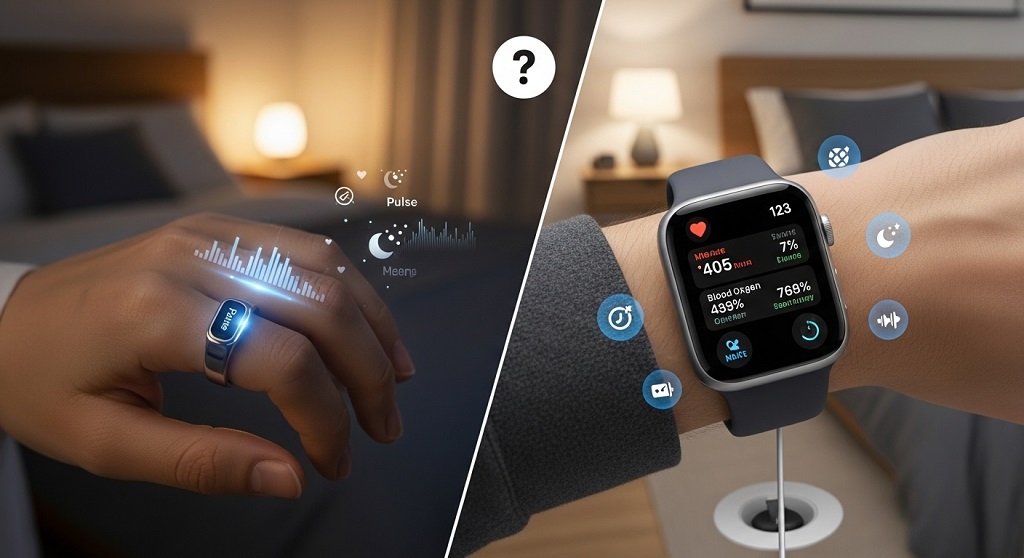
Short answer: Smart rings provide deeper recovery analysis using HRV and temperature trends.
Recovery tracking includes:
- Sleep quality scores
- Body temperature changes
- Stress indicators
- Resting heart rate patterns
Smart rings convert this data into readiness scores that estimate whether your body is prepared for physical or mental activity.
The Apple Watch provides similar signals but usually requires third-party apps for full recovery scoring.
Is the Apple Watch Better for Users Who Want an All-in-One Health Device?
Short answer: Yes. The Apple Watch is better if you want sleep tracking combined with fitness tracking, messaging, and daily productivity tools.
The Apple Watch supports:
- Workout tracking
- ECG monitoring
- Blood oxygen measurement
- Fall detection
- Smart notifications
- App ecosystem integration
If sleep tracking is only one part of your health routine, the Apple Watch delivers more value overall.
Which Device Is Better for Long-Term Sleep Habit Improvement?
Short answer: Smart rings are better for long-term sleep habit tracking because they prioritize recovery metrics instead of daily alerts.
Behavior change depends on consistency. Smart rings encourage this through:
- Minimal distraction design
- Automatic tracking
- Recovery-based recommendations
- Sleep timing guidance
Some users find smartwatch notifications reduce sleep quality instead of improving it.
Choosing a low-interruption device supports healthier sleep routines.
How Do Subscription Costs Affect the Choice?
Short answer: Smart rings often require subscriptions, while Apple Watch sleep tracking works without one.
Cost structure comparison:
- Smart ring purchase price: high upfront
- Monthly analytics subscription: common
- Apple Watch analytics: included
- Optional third-party apps: paid
Over two years, subscription costs can influence the total ownership value significantly.
Which Device Is Better for Athletes and Active Users?
Short answer: The Apple Watch is better for athletes who need workout tracking plus sleep monitoring.
Athletes benefit from:
- GPS workout tracking
- Heart rate zones
- VO2 max estimation
- Training load metrics
Smart rings complement training but rarely replace dedicated fitness tracking devices.
Which Device Is Better for Minimalists Focused Only on Sleep Quality?
Short answer: Smart rings are better for users focused purely on sleep optimization.
Minimalist users prefer:
- No notifications
- No screens
- No distractions
- Passive monitoring
This leads to better adherence and more reliable sleep pattern insights.
Conclusion: Should You Choose a Smart Ring or an Apple Watch for Sleep Tracking?
Choosing between a smart ring and an Apple Watch depends on your primary goal.
If your focus is improving sleep quality, recovery tracking, and long-term consistency, a smart ring is usually the better choice. Its comfort, battery life, and temperature-based analytics support deeper insights.
If you want a complete health ecosystem that includes workouts, notifications, ECG tracking, and daily activity monitoring, the Apple Watch offers more versatility.
The best strategy is to match your device with your behavior. A wearable only improves sleep if you wear it consistently.
Start by identifying your main objective. Are you tracking recovery or managing overall health? Once that is clear, your decision becomes simple.
If better sleep is your priority this year, choose the device you will actually wear every night. That single habit change can improve energy, focus, and long-term health outcomes.
FAQ: Smart Ring vs Apple Watch for Sleep Tracking
Is a smart ring more accurate than an Apple Watch for sleep tracking?
Smart rings often provide more stable heart rate variability readings because the finger offers stronger pulse signals. However, both devices estimate sleep stages with similar reliability.
Can the Apple Watch track REM sleep accurately?
Yes. Apple Watch uses motion sensors and heart rate variability models to estimate REM sleep. Accuracy is comparable to other advanced consumer wearables but not equal to clinical sleep studies.
Do smart rings work without a subscription?
Some smart rings require a subscription for advanced analytics such as readiness scores and long-term sleep trends. Basic sleep tracking usually works without one.
Which device has better battery life for overnight tracking?
Smart rings typically last four to seven days on a single charge. Apple Watch batteries usually require daily charging, which can interrupt overnight tracking.
Is wearing an Apple Watch during sleep uncomfortable?
Comfort depends on personal preference. Some users adapt quickly, but side sleepers often prefer smart rings because they are lighter and smaller.
Can sleep trackers replace medical sleep studies?
No. Consumer sleep trackers provide behavioral insights but cannot diagnose sleep disorders such as sleep apnea. Clinical testing remains necessary for diagnosis.
Which device is better for improving sleep habits?
Smart rings are often better for habit improvement because they provide recovery-based feedback without notifications that disrupt sleep routines.
Related Topics: How to Set Up a Portable Power System for Travel Tech (Step‑by‑Step)
What Next: How to Explore Futuristic Devices with Gadgets Hyperlogic Insights
