


09 Aug How PWAs Improve User Engagement and Conversion Rates
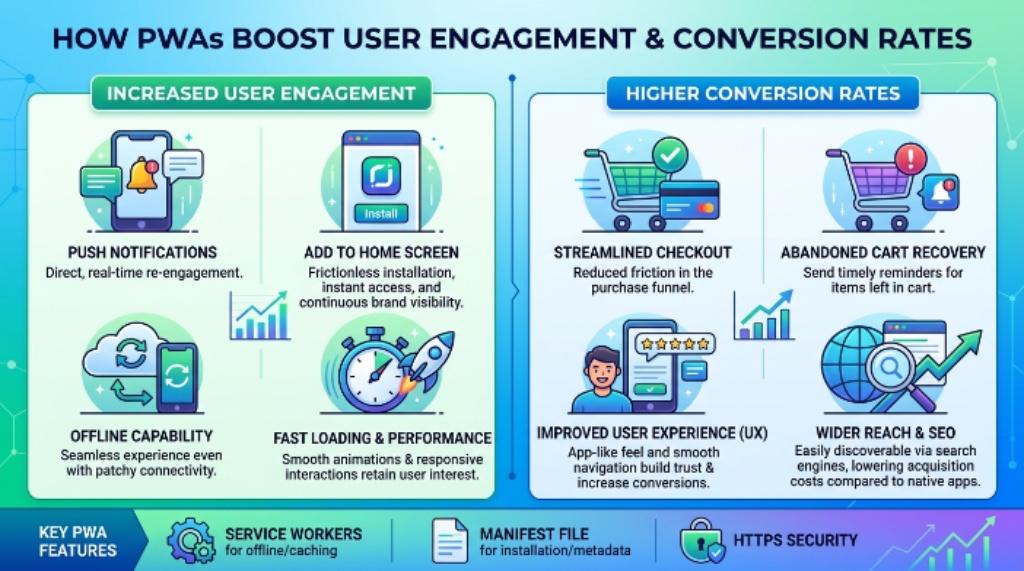
Progressive Web Apps improve user engagement and conversion rates by delivering faster loading, offline access, app like experiences, and timely re engagement features. Users interact more often because PWAs reduce friction, while businesses benefit from higher retention, stronger customer loyalty, and increased completed actions.
Many businesses have reported meaningful improvements after adopting PWAs. Some organizations achieved multiple times higher conversion rates, while others increased user sessions by more than 150 percent through faster experiences and improved engagement features. These results explain why PWAs continue gaining attention across ecommerce, publishing, education, and service industries.
What Is a Progressive Web App?
A Progressive Web App is a website enhanced with modern technologies that create an app like experience. Users access it through a browser while enjoying features commonly associated with mobile applications.
Unlike traditional mobile apps, a PWA does not require installation through an app store. Visitors can quickly add it to their device home screen for faster future access.
Why User Engagement Matters
User engagement measures how actively visitors interact with your website. High engagement often leads to stronger trust, longer visits, and more completed goals.
Better engagement also creates additional opportunities for purchases, registrations, bookings, and subscriptions. Therefore, improving user experience directly supports business growth.
How PWAs Increase User Engagement
Faster Loading Speeds
Speed remains one of the strongest engagement factors. Users rarely wait for slow websites to finish loading.
PWAs store important files locally after the first visit. Consequently, returning visitors enjoy significantly faster page loading and smoother navigation.
Reliable Offline Access
Internet connections often become unstable during travel or crowded events. Traditional websites usually stop working when connectivity disappears.
PWAs continue showing previously loaded content through offline caching. Therefore, users remain productive until the connection returns.
Home Screen Installation
Visitors can save a PWA directly on their device home screen. This simple process removes unnecessary installation barriers.
As a result, users launch the website like a regular application. Frequent access naturally encourages repeat visits.
Smooth App Like Experience
PWAs provide responsive layouts and intuitive navigation across devices. Every interaction feels consistent and familiar.
Users move between pages without unnecessary interruptions. Consequently, browsing becomes faster and more enjoyable.
Push Notifications
Relevant notifications encourage users to return after leaving the website. Businesses can share updates, reminders, and personalized offers.
However, notifications should always provide genuine value. Otherwise, excessive messages may reduce user satisfaction.
How PWAs Improve Conversion Rates
Reduced Bounce Rates
Visitors often leave slow websites before exploring available products or services. Faster experiences encourage users to continue browsing.
Lower bounce rates increase opportunities for purchases, registrations, and inquiries. Therefore, conversion rates naturally improve.
Simpler Customer Journey
Every unnecessary step creates additional friction during the buying process. PWAs simplify navigation from discovery to checkout.
Users complete tasks faster because important information remains easily accessible. Consequently, fewer visitors abandon their journey.
Better Mobile Performance
Most online traffic now comes from smartphones. Mobile users expect quick responses and smooth interactions.
PWAs optimize experiences across different screen sizes. Therefore, mobile visitors complete more valuable actions.
Improved Returning Visitor Rates
Repeat visitors usually convert more often than first time users. PWAs encourage these return visits through convenient access.
Home screen installation and valuable notifications help maintain ongoing customer relationships. Stronger loyalty supports long term business success.
Key PWA Features That Support Engagement
The following features contribute directly to better user experiences.
- Fast page loading
- Offline functionality
- Secure browsing through HTTPS
- Responsive design
- Home screen installation
- Background updates
- Push notifications
- Reliable performance
- Cross platform compatibility
- Lower data usage

Industries That Benefit Most From PWAs
Many business types achieve measurable improvements after implementing PWAs.
- Ecommerce stores
- Online marketplaces
- News websites
- Educational platforms
- Healthcare portals
- Financial services
- Travel companies
- Food delivery businesses
- Event platforms
- Software services
Best Practices for Maximizing PWA Results
Focus on Performance First
Every improvement should begin with loading speed. Compress images and optimize code for better responsiveness.
Fast experiences encourage visitors to continue exploring. Therefore, performance should remain a top priority.
Deliver Valuable Notifications
Only send notifications when users receive meaningful benefits. Personalized messages perform better than generic announcements.
Relevant reminders improve engagement without creating frustration. Quality always matters more than quantity.
Simplify Navigation
Visitors should locate important information quickly. Clear menus reduce confusion and improve satisfaction.
Simple navigation also shortens the path toward important business goals. Therefore, conversions become easier to achieve.
Optimize Every Screen
Users frequently switch between desktops, tablets, and smartphones. Every device deserves an excellent experience.
Responsive layouts maintain consistency across screen sizes. Consequently, users remain comfortable regardless of their device.
Encourage Home Screen Installation
Offer installation prompts after users experience value from the website. Early prompts often receive lower acceptance.
Well timed suggestions increase installation rates naturally. Returning visitors then enjoy even greater convenience.
Common Mistakes to Avoid
Several mistakes reduce the effectiveness of PWAs.
- Sending excessive notifications
- Ignoring mobile usability
- Using large unoptimized images
- Creating confusing navigation
- Forgetting offline testing
- Neglecting accessibility
- Delaying performance improvements
- Providing inconsistent user experiences
Measuring PWA Success
Tracking the right metrics helps evaluate business performance.
- Conversion rate
- Bounce rate
- Session duration
- Returning visitor percentage
- Home screen installations
- Notification engagement
- Cart completion rate
- Average page load time
- Customer retention
- Revenue growth
Regular monitoring reveals improvement opportunities. Data driven decisions produce stronger long term results.
Future Outlook for PWAs
Browser technology continues expanding PWA capabilities. New features improve performance, security, and user convenience.
Businesses increasingly recognize the value of maintaining one high quality web experience across multiple devices. Consequently, PWAs remain an attractive solution for organizations seeking efficient digital growth.
Conclusion
Progressive Web Apps improve engagement because they deliver faster experiences, reliable performance, and convenient user interactions. Those improvements also increase customer satisfaction and support stronger conversion rates across many industries.
If your business depends on mobile visitors and repeat customers, investing in a well built PWA can produce measurable long term value. Start by improving speed, simplifying navigation, and creating meaningful engagement opportunities.
FAQ
What is the biggest advantage of a PWA?
A PWA combines website accessibility with app like performance to improve user experience.
Do PWAs increase conversion rates?
Yes, faster performance and smoother user journeys often lead to higher conversion rates.
Can a PWA work without internet access?
Yes, cached content allows many PWA features to continue working offline.
Are PWAs suitable for ecommerce websites?
Yes, ecommerce businesses frequently use PWAs to improve shopping experiences and customer retention.
Do users need an app store to install a PWA?
No, users can install most PWAs directly from a supported web browser.
